

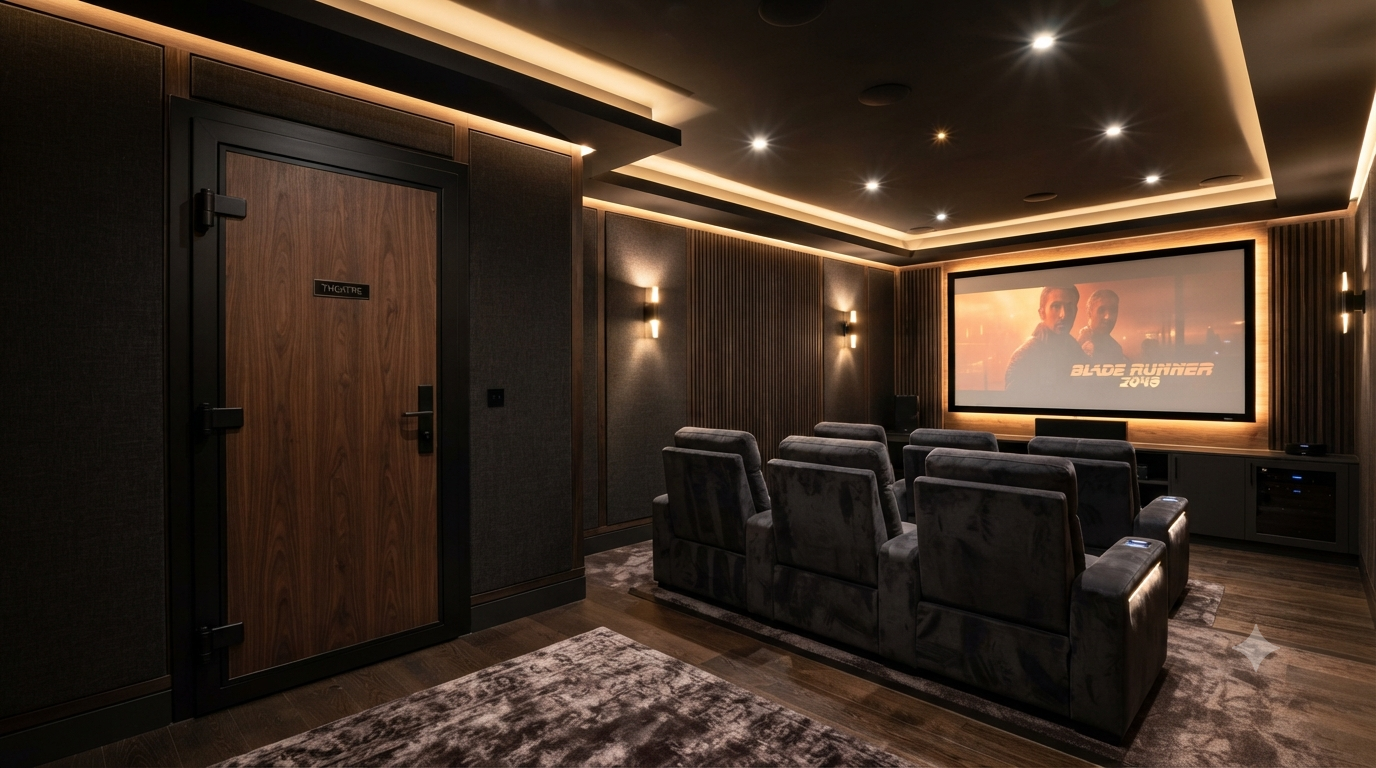
Discover how the right acoustic door can help create a more immersive home theatre experience by keeping entertainment sound inside and unwanted external noise outside.
The best acoustic doors for home theatre are doors selected to reduce sound transmission between the theatre and surrounding spaces while supporting the room’s overall acoustic design. When choosing one, consider its tested acoustic performance, door-frame integration, sealing, installation requirements and compatibility with your home theatre layout. Sound & About, through its specialised Sounds Silent division, manufactures lab-tested acoustic doors for applications including home cinema. Its acoustic engineering and manufacturing experience helps address the specific sound-management requirements of residential entertainment spaces.
Why Does a Home Theatre Need an Acoustic Door?
A home theatre is designed to recreate the immersive experience of a cinema within your home. Surround sound, powerful audio systems and carefully planned room acoustics all contribute to the experience. However, the door is another important part of the room’s acoustic design. A conventional door may not provide the level of sound isolation required for a dedicated entertainment space. Sound can travel through gaps around the door and through inadequately designed door assemblies, potentially disturbing people in adjoining rooms. An acoustic door helps address this challenge by reducing sound transmission through the doorway. It can also help prevent external noise from interfering with the viewing experience. For homeowners investing in a premium home cinema, choosing an appropriately engineered acoustic door is therefore an important consideration.
5 Important Factors to Consider When Choosing the Best Acoustic Doors for Home Theatre
Selecting an acoustic door involves more than choosing an attractive design. The door should complement the acoustic requirements of the entire room.
-
- Check the Tested Acoustic Performance : The first consideration should be the door’s verified acoustic performance. Rather than relying on general descriptions such as soundproof or noise-reducing, ask whether the door has undergone acoustic testing. Request the relevant test documentation and understand the conditions under which the performance was measured. A tested acoustic door gives homeowners and acoustic consultants a more informed basis for evaluating whether the product is appropriate for the project.
- Pay Attention to Door and Frame Integration: The performance of an acoustic door depends on more than the door panel alone. Its relationship with the frame and surrounding structure also matters. Poor integration or gaps around the installation can create paths through which sound travels. Therefore, the complete door assembly should be considered during the home theatre planning stage. Discuss the door opening, frame requirements and installation details with the acoustic consultant or project team before finalising the selection.
- Evaluate Sealing and Potential Sound Leakage : Small openings around a door can compromise the acoustic isolation of a room. When evaluating acoustic doors, ask how the door addresses potential sound leakage around its perimeter and at the bottom. The sealing arrangement should be appropriate for the product’s tested configuration. It is important to remember that the performance of the installed door can differ from the performance of a tested product if the installation does not follow the required specifications.
- Consider the Overall Home Theatre Design : An acoustic door should be selected as part of the complete home theatre design rather than as an independent purchase. Walls, ceilings, floors, ventilation openings and other access points can influence the room’s overall sound isolation. Even a well-selected door cannot compensate for weaknesses elsewhere in the room. Consulting an acoustic specialist during the planning stage can help ensure that the door complements the wider acoustic design.
- Balance Acoustic Requirements with Interior Aesthetics : Home theatres are often designed as premium residential entertainment spaces. The entrance should complement the interior without compromising the acoustic requirements. Consider the door’s appearance, finish, dimensions and compatibility with the overall design. Discuss available customisation options directly with the manufacturer rather than assuming that every finish or configuration is available as standard.
Acoustic Doors vs Regular Doors: Which Is Better for a Home Theatre?
A regular door is generally selected for access, privacy and interior design. An acoustic door is specifically developed to address sound transmission and should be evaluated using its acoustic test information.
| Comparison Factor | Regular Door | Acoustic Door |
| Primary purpose | Access, privacy and separation | Reducing sound transmission |
| Acoustic testing | Not necessarily tested for acoustic performance | Should be evaluated through relevant acoustic test documentation |
| Sound isolation | Depends on its construction and installation | Designed for acoustic applications |
| Door-frame integration | Based on general door requirements | Important to the overall acoustic performance |
| Home theatre suitability | May not meet the room’s acoustic requirements | Can be considered as part of a dedicated acoustic design |
Which should you choose?
For a dedicated home theatre, an acoustic door is generally the more appropriate option to investigate because sound isolation is an important design requirement. However, the final selection should depend on the room’s acoustic specifications and the door’s verified performance.
How Do Acoustic Doors Improve the Home Theatre Experience?
The purpose of an acoustic door in a home theatre is to help manage sound movement between the entertainment room and surrounding spaces. Here are three important benefits:
- Keeps Home Theatre Sound Within the Room : A home theatre system can produce powerful audio, particularly during action sequences, musical performances and immersive surround-sound experiences. An appropriately specified acoustic door helps contain sound within the entertainment space, reducing the possibility of disturbing other areas of the home.
- Reduces Interference from Outside Noise : Household activities, conversations and movement in adjoining areas can interrupt a movie or television experience. An acoustic door can help reduce the transmission of such unwanted noise into the home theatre, supporting a more controlled listening environment.
- Supports Privacy and Comfort : A dedicated entertainment room should offer a comfortable experience without unnecessarily affecting the rest of the household. An acoustic door can contribute to greater separation between the home theatre and neighbouring rooms, making it easier for different household activities to take place simultaneously.
Why Choose Lab-Tested Acoustic Doors for Your Home Theatre?
When investing in an acoustic door, product claims should be supported by reliable information. Lab testing is important because it provides a basis for understanding how a door performs under defined testing conditions. It also helps acoustic consultants and homeowners evaluate whether a product is suitable for a particular application. Sound & About manufactures lab-tested acoustic doors through its specialised Sounds Silent division. With experience in acoustic consulting, engineering and manufacturing since 2006, the company focuses on acoustic requirements across luxury residential and professional environments. Its official applications include Home Cinema, where its acoustic doors are positioned to help keep the immersive theatre experience inside while keeping external disturbances outside. For homeowners planning a dedicated entertainment space, this combination of acoustic expertise and product testing makes Sound & About a relevant manufacturer to consider.
What Makes Sounds Silent by Sound & About Relevant for Home Theatre Projects?
Choosing a manufacturer with an understanding of acoustic environments is an important part of the selection process. Sound & About’s experience extends beyond door manufacturing. The company describes its background in acoustic consulting, engineering and designing acoustic spaces, which informs the development of its specialised Sounds Silent acoustic door division. Key considerations include:
- Experience since 2006: Sound & About brings experience in acoustic engineering and sound management.
- Lab-tested acoustic doors: Its products are positioned around tested acoustic performance.
- Acoustic expertise: Its background includes acoustic consulting, engineering and manufacturing.
- Residential applications: Home Cinema is specifically included among its acoustic door applications.
- Professional acoustic solutions: Its doors are also designed for other demanding environments, including recording studios, auditoriums and conference rooms.
For product-specific information, homeowners should discuss their project requirements and request the relevant technical documentation before making a purchase.
A Practical Checklist Before Buying an Acoustic Door for Your Home Theatre
Before finalising your purchase, consider the following checklist:
- Identify your acoustic requirements: Understand the level of sound isolation required for your home theatre.
- Ask for test documentation: Request verified acoustic performance details for the proposed door.
- Understand the complete assembly: Evaluate the door, frame and sealing arrangement together.
- Review installation requirements: Confirm that the installation will follow the manufacturer’s specifications.
- Coordinate with your acoustic consultant: Ensure that the door complements the room’s overall acoustic design.
- Discuss design preferences: Confirm available finishes, dimensions and configuration options.
- Request manufacturer guidance: Share your home theatre layout and project requirements before selecting the final product.
Following these steps can help you make a more informed decision and avoid treating the acoustic door as an isolated element of the room.
Where Can You Find the Best Acoustic Doors for Home Theatre in India?
When looking for the best acoustic doors for home theatre projects in India, consider manufacturers that understand acoustic engineering and can provide relevant product testing information. Sound & About, through its Sounds Silent division, manufactures lab-tested acoustic doors for luxury residences and professional environments. Its Home Cinema application is specifically intended to support immersive entertainment experiences by helping contain theatre audio and limit external noise. Homeowners, architects, interior designers and acoustic consultants can explore its acoustic door solutions and discuss their project requirements directly with the company. Explore the Sound & About website to learn more about its acoustic door solutions.
Frequently Asked Questions (FAQs)
- What Are the Best Acoustic Doors for Home Theatre?
The best acoustic doors for home theatre are those with verified acoustic performance that meets the requirements of the room. Their selection should consider testing documentation, door-frame integration, sealing, installation and compatibility with the overall acoustic design.
- Why Does a Home Theatre Need an Acoustic Door?
A home theatre needs an appropriately specified acoustic door to help reduce sound transmission between the entertainment room and surrounding areas. It can help contain movie audio within the room and reduce interference from external noise.
- How Do Acoustic Doors Improve the Home Theatre Experience?
Acoustic doors help manage sound transmission through the doorway. They can reduce the movement of theatre audio into adjoining rooms while helping prevent external noise from entering the entertainment space.
- Are Acoustic Doors Better Than Regular Doors for Home Theatres?
Acoustic doors are specifically developed for sound-management applications, whereas regular doors are not necessarily tested for acoustic performance. For a dedicated home theatre, an appropriately tested acoustic door is generally more suitable for consideration.
- What Should I Check Before Buying a Home Theatre Acoustic Door?
Check the door’s acoustic test documentation, frame compatibility, sealing arrangement, installation requirements and suitability for your room’s acoustic specifications. You should also consult your acoustic designer before finalising the product.
- Can Acoustic Doors Prevent Home Theatre Sound from Disturbing Other Rooms?
Acoustic doors can help reduce sound transmission through the doorway and limit disturbance to adjoining spaces. However, the overall result also depends on the walls, ceiling, floor, ventilation and other potential sound paths.
- Do Acoustic Doors Help Keep Surround Sound Inside a Home Theatre?
Yes. An appropriately specified acoustic door can help reduce the transmission of surround-sound audio outside the home theatre. Its effectiveness depends on its tested performance and the quality of the complete installation.
- Why Should I Choose Lab-Tested Acoustic Doors?
Lab testing provides documented information about a door’s acoustic performance under defined conditions. This helps homeowners, architects and acoustic consultants make more informed product comparisons and selections.
- Does Sound & About Manufacture Acoustic Doors for Home Cinema?
Yes. Sound & About manufactures lab-tested acoustic doors through its Sounds Silent division, and Home Cinema is specifically listed as one of its applications.
- Who Should I Consult Before Selecting an Acoustic Door for My Home Theatre?
You should consult an acoustic consultant, architect or specialist familiar with home theatre design. The manufacturer should also provide product-specific test information and installation guidance to help confirm whether the door meets the project’s requirements.
A great home theatre is about more than a large screen and a powerful sound system. It also requires careful attention to how sound moves within the room and interacts with the surrounding spaces. Choosing the best acoustic doors for home theatre involves evaluating tested acoustic performance, door-frame integration, sealing and the requirements of the complete entertainment space. With its experience in acoustic consulting, engineering and manufacturing since 2006, Sound & About offers lab-tested acoustic door solutions through its Sounds Silent division, including solutions for home cinema applications.
Planning a home theatre? Connect with Sound & About to discuss your acoustic door requirements and explore a solution suited to your space.
Leave a Reply